I Think You Can
I shoved the bike as hard as I could and let go.
As a parent, I was never convinced my life lessons landed with my kids.
One cool late September morning in Georgia, while lacing up my running shoes, I looked over at my ten-year-old daughter, Kristen, drawing at the kitchen table. Sixty-four brand-new crayons were strewn about, totally emptied from their yellow box.
A mop of thick blond hair hung around her face. Her bare feet were tucked under her, on the wooden chair. Still in her nightgown, she clearly was not dressed for outdoor play.
“Let’s go outside,” I said. “You ride your bike, and I’ll jog by you.”
Kristen looked up at me, her long eyelashes framing her baby blue eyes.
“Come on,” I said. “It’ll be fun! Go get dressed.”
She rolled her eyes. However, she left the table and put on pink sweatpants and a worn Braves sweatshirt. Moving at glacial speed, she donned a helmet and grabbed her bike.
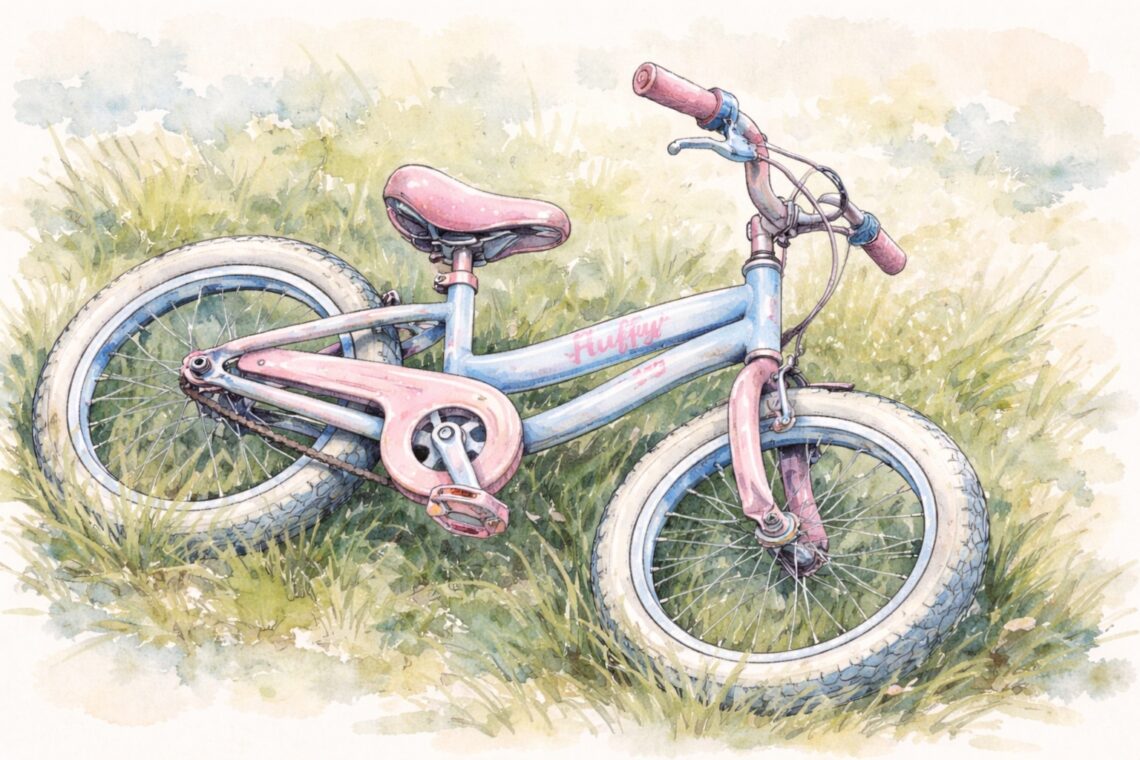
We set out, Kristen aboard her Huffy bike and me in my black-and-white Nikes.
The air was crisp and the sky a shade of blue that only arrives after autumn’s winds. The smell of freshly mown lawns, still clinging to summer, filled my nose.
Our neighborhood sat perched on a ridge high above a man-made lake. Another subdivision sat on the opposite side of the lake. The two were joined by an asphalt road flanked by a broad concrete sidewalk.
Freshly laid, the sidewalk coursed down a steep hill to run alongside the lakeshore, where the ground was flat and grassy. It then gently rose, tall pine trees casting long shadows over its surface.
That was my running course. Our house, down our quiet street, onto the sidewalk next to the road, past the lake, and then over to the next subdivision. That was a mile and a half. Turn around, retrace my steps, and arrive home to complete a three-mile run.
We started out on our street. Kristen rode slowly so I could easily keep pace with her. We turned right and hit the concrete sidewalk. It was wide enough that she could ride on it, with me following closely behind.
Gray Canada geese flew low to land on the lake, aiming their feet and splashing as they hit the water. Kristen coasted down the hill toward the lake’s edge while I hustled to keep up with her.
The next half mile, flat and tree-lined, sped by easily. We made it to the halfway point and turned around to head back. In front of us, the steep hill loomed. While easy to cruise down, it was a chore to climb up.
Kristen stopped.
“Honey, don’t stop,” I called to her. I hadn’t quite caught up.
“I can’t get up the hill,” she said.
“You can do this. Believe!” I said, huffing. Finally reaching her, I bent over with a stitch in my side. A light breeze came off the lake, cooling my sweaty forehead.
Kristen laid her bike down on the sidewalk. “No, I can’t.”
I scoured my brain for an inspired parenting tip. I could easily push the bike, and she could walk up the hill. But that was a cop-out.
I wanted her to at least try.
It came to me. The Little Engine That Could.
“Kristen,” I said. “Get back on your bike. Do you remember the story of the Little Engine?”
She shook her head, pursing her rosy Cupid’s bow lips.
“Well, there was a small train engine. She was so tiny that the bigger, proud engines mocked her size.”
Kristen sighed and mounted her bike.
The uphill battle
“Pedal, honey,” I said. I gripped her handlebars and the back of her seat, then pushed. I knew pedaling up the hill would be tough — for anyone. I wondered what she was thinking but didn’t ask.
“One day,” I continued, “a terrible storm was predicted. Stuck on the wrong side of a huge mountain was a heavy cargo of toys and food for children. Afraid of the on-coming weather, the big engines all refused to pull the load. The little engine spoke up. ‘I think I can,’ she said.”
Grunting under the effort of pushing uphill, I managed to continue: “No one thought she could.”
“They hitched the cargo to the little engine. She started chugging and pulling. ‘I think I can,’ she said. ‘I think I can.’ She said it over and over until she reached the peak.”
Kristen’s eyes opened wide as she listened. She pedaled harder.
“When she crested the mountain, the little engine exclaimed, ‘I thought I could!’”
With that, puffing as hard as the train in the story, I shoved the bike and let go.
“I think I can, I think I can, I think I can,” I heard Kristen say, pumping in rhythm to each phrase.
My throat tightened. She needed to try. Would she?
She reached the top and kept pedaling. And then I couldn’t see her.
A car raced past me, blowing dirt in my eyes. “Kristen!” I yelled, my heart racing.
I took off, running as fast as I could up the rest of the incline, frantically searching for a glimpse. My foot missed the sidewalk, hitting the edge.
As I fell, I thought, I can’t break my wrist. Instead of bracing with my hand, I hit the sidewalk with my arm and rolled. My face skimmed the concrete.
Like a radio signal, pain radiated from parts of my body: my shin, my knee, my face, my hand, and my elbow. Cars zipped by. No one stopped.
Picking myself up, I surveyed the damage. Nothing seemed broken, but I was bleeding from multiple abrasions. My stomach churned with worry for Kristen’s safety.
Clenching my jaw, I limped home, body parts howling.
As I neared the house, I saw Kristen’s bike lying on its side in our front yard. A wave of relief spilled over me. Opening the front door, I saw Kristen at the kitchen table drinking a glass of milk, crayon in hand.
“Why did you leave me?” I asked.
Kristen looked up. “Mom, your face! It’s got blood all over it!”
“I tripped and fell,” I said. Stiffness spread through my muscles. “I’m going to take a shower.”
“Mom!” Kristen said. “I got up the hill when I started thinking I could — just like the engine.”
I leaned over and kissed her head.
“I knew you could,” I whispered.
Believing
Twenty-five years later, Kristen, with her feet tucked under her body, sat with me on my deck on Tybee. An early-morning fog shrouded the lapping ocean waves and misted our faces.
“Mom,” she said, holding a cup of steaming coffee. “Do you remember the time you told me the story of the little engine that could?”
“Oh, yeah,” I replied. “I made you come with me on my run. You rode your bike and couldn’t get up the hill by our house.”
“Yes,” she said. “I just wanted you to know that I use ‘I think I can’ all the time. Whenever I feel something is too hard. Or I doubt myself.”
“Really?” I asked.
She stood up and kissed me on the cheek. “Thank you, Mom, for believing.”
My eyes dampened. In that moment, I knew that when I couldn’t be there, she had something I gave her to help.
I had pushed her hard enough that she could do the rest on her own.
A cool breeze lifted the fog. Together, we watched the shoreline take shape.
